
Is an Under-bench Filter Right for You?

Updated: 2 days ago

Good-quality drinking water is something you use every day. Whether you want to improve the taste of your town water, enjoy greater confidence in your rainwater supply or address a particular water-quality concern, the right filtration system can make a real difference.
An under-bench water filter is a popular option for households wanting better drinking water without installing a system throughout the entire home. Compact and discreet, it sits beneath the kitchen bench and treats water where you need it most.
But under-bench filtration is just one option. Different filtration technologies address different water-quality concerns, and the best solution depends on your water supply, your priorities and how you use water around your property.
At WTS, we help customers find practical filtration solutions for their homes, tanks and wider water systems. Here's how to decide which option is right for you.
Why consider an under-bench water filter?
An under-bench filter provides a convenient way to treat drinking water at the kitchen sink while keeping the equipment neatly tucked away.
For many households, the biggest attraction is the opportunity to improve the everyday drinking-water experience without the cost or complexity of treating every tap in the house.
Depending on the system and the filtration technology used, benefits can include:
Better taste and odour: suitable carbon filters can reduce chlorine taste and odour, making drinking water more enjoyable.
Targeted filtration: choose a system designed to address the particular water-quality concerns you have.
A discreet installation: keep filtration equipment out of sight beneath the kitchen bench.
Convenient access to filtered water: enjoy treated water for drinking, filling bottles, making tea and coffee, and preparing food.
A manageable maintenance routine: replaceable cartridges make it straightforward to maintain many systems when you follow the manufacturer's recommendations.
An under-bench filter can be a particularly good fit when your main objective is better drinking water at the kitchen sink, rather than treating every outlet throughout the property.
Which type of water filtration is right for you?
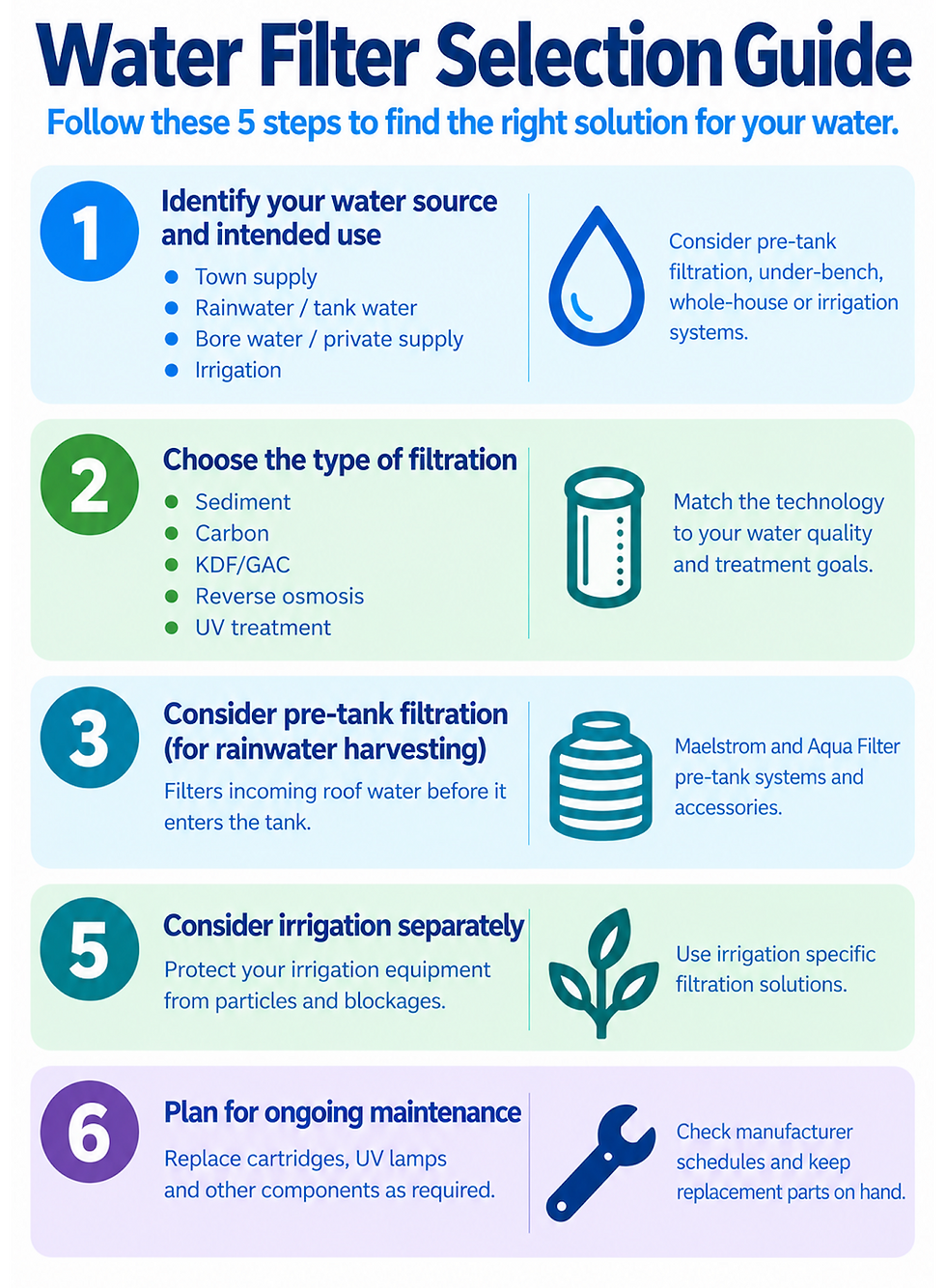
Not all filters work in the same way. Understanding the benefits of each technology will help you choose a system that matches your water and your priorities.

Sediment filtration:
capture particles and protect downstream equipment
Sediment filtration is often an important part of a well-designed water treatment system.
Sediment filters capture suspended particles such as dirt, rust and other debris. By reducing the particle load entering downstream equipment, they can help protect finer filters and other components from premature blockage.
For rainwater systems, private supplies and applications where suspended particles are present, the right sediment filter can make an important contribution to the overall treatment process.
Sediment filtration may suit you if you want to:
Capture visible and fine suspended particles.
Help protect downstream filtration equipment.
Reduce sediment entering household or water-treatment systems.
Include an appropriate pre-filtration stage before more specialised treatment.
WTS stocks Polyspun and Polypleat cartridges in different filtration ratings. The correct rating depends on the incoming water, the required flow and the equipment being protected.
Carbon filtration: improve taste and odour
If your town water has a noticeable chlorine taste or odour, carbon filtration is a good place to start.
Activated carbon is widely used in drinking-water filtration because it can adsorb chlorine and certain other substances, depending on the media and system design. This can help produce water that tastes and smells better, making it more pleasant to drink and use in hot drinks and cooking.
Carbon filters are available in different designs, including carbon block and granular activated carbon cartridges. The right option depends on the application, required flow and the performance of the particular filter.
Carbon filtration may suit you if you want to:
Improve the taste and odour of treated town water.
Enjoy more pleasant drinking water at the kitchen tap.
Add targeted filtration to an existing water supply.
Maintain a convenient drinking-water system with replaceable cartridges.
WTS offers under-bench carbon filtration options, along with a selection of replacement carbon cartridges for compatible systems.
KDF/GAC filtration: combine complementary filtration media
Some filters combine KDF media with granular activated carbon (GAC). The two media work through different mechanisms, providing a combination approach to filtration.
Activated carbon is commonly used to improve taste and odour, while KDF media can contribute to the reduction of certain substances in suitable applications. The benefits depend on the specific cartridge design and its verified performance.
Combination filtration can be worth considering when you want a multi-media cartridge tailored to particular water-treatment requirements.
KDF/GAC filtration may suit you if you want to:
Combine different filtration media in one cartridge.
Address defined water-quality concerns with a suitable combination filter.
Add targeted filtration to an under-bench or inline system.
WTS offers KDF/GAC cartridge options for compatible installations. If you are targeting a particular contaminant, check the product's performance information to ensure the selected cartridge is suitable.
UV treatment:
add microbiological protection
If your home relies on rainwater or another private water supply, microbiological treatment may be an important consideration.
Ultraviolet (UV) treatment uses UV light to inactivate susceptible microorganisms as water passes through a correctly designed treatment chamber. It can be an effective part of a treatment system where microbiological risks need to be managed.
UV is particularly useful because it treats water as it passes through the unit without relying on the addition of a chemical disinfectant. However, effective treatment depends on suitable incoming water quality, correct sizing, the required UV dose and flow, and ongoing maintenance.
UV treatment may suit you if you want to:
Include microbiological treatment in a private water supply.
Add a dedicated disinfection stage to a suitable filtration system.
Treat water for household use where UV is an appropriate solution.
Build a more comprehensive treatment system around your water-quality requirements.
UV works best as part of an appropriately designed system. Sediment and other particles can interfere with treatment, so suitable pre-filtration is important. UV also does not remove dissolved chemicals, metals or sediment.
WTS offers UV systems and associated equipment for a range of applications, with system selection based on water quality, flow requirements and the treatment performance needed.
Reverse osmosis: reduce a wider range of dissolved substances
If you want to go beyond conventional sediment and carbon filtration, reverse osmosis (RO) is another option to consider.
An RO system passes water through a semi-permeable membrane that reduces a range of dissolved substances. Depending on the system and operating conditions, this can provide a more extensive level of treatment than a standard carbon cartridge alone.
RO may be suitable for households concerned about particular dissolved contaminants or seeking a more comprehensive drinking-water treatment process.
Reverse osmosis may suit you if you want to:
Reduce a range of dissolved substances in drinking water.
Address specific water-quality concerns where RO is an appropriate treatment.
Combine membrane treatment with additional filtration stages.
Have a dedicated drinking-water system beneath the kitchen bench.
WTS offers under-bench reverse osmosis systems, along with compatible replacement membranes, cartridges, carbon post-filters and remineralising filters.
Like any filtration system, RO requires appropriate maintenance. The system also produces reject water, so water efficiency and operating requirements are worth considering when choosing a model.
Your goal | Filtration options to consider | Main benefits |
Better-tasting drinking water | Carbon, KDF/GAC, reverse osmosis | Improve taste and odour; reduce selected substances |
Reduce chlorine taste and smell | Activated carbon, KDF/GAC | Improve the taste of treated town water |
Remove dirt, rust or sediment | Polyspun, pleated or other sediment filters | Capture suspended particles and help protect equipment |
Reduce specific dissolved contaminants | Suitable specialist media, KDF/GAC or reverse osmosis | Target particular water quality concerns |
More comprehensive drinking-water treatment | Multi-stage filtration or reverse osmosis | Combine treatment methods to address several concerns |
Treat rainwater or bore water for household use | Sediment filtration, appropriate specialist treatment and UV | Improve water quality and provide microbial treatment |
Filter water throughout the home | Whole-house filter housings or combined treatment systems | Treat water before it reaches household outlets |
Keep debris out of a rainwater tank | Pre-tank filtration | Remove leaves and larger debris before storage |
Protect irrigation equipment | Screen, disc or other irrigation filters | Reduce blockages in emitters, valves and sprinklers |
What if you use rainwater or bore water?
An under-bench filter can be useful for drinking water, but private water supplies often need a broader approach.
Rainwater harvesting
The quality of tank water is influenced by your roof and gutters, surrounding environment, tank condition and maintenance.
Pre-tank filtration can help manage debris and suspended material before roof-collected water enters storage. Additional filtration and treatment may then be required to make the water suitable for its intended use.
For household drinking water, the appropriate system may combine sediment filtration with UV treatment or other methods selected for the water-quality concerns identified.
Bore water
Bore water can vary considerably between properties. Depending on the source, treatment may be needed for sediment, dissolved minerals, metals or microbiological contaminants.
Where the water quality is unknown, testing helps establish which treatment methods are appropriate. This allows you to select filtration for the actual issue rather than relying on a general-purpose cartridge.
Town water
For homes connected to a municipal supply, an under-bench carbon filter may be all that is needed if the main objective is to improve chlorine taste and odour.
If you want to address a particular contaminant or treat water throughout the house, consider the performance and capacity required from the complete system.
Should you choose under-bench or whole-house filtration?
The right system depends on where you want treated water and what you need to achieve.
Under-bench filtration
Best suited to households focused on drinking water at the kitchen sink.
An under-bench system is compact, keeps equipment out of sight and allows you to target filtration where it is most useful.
Inline or Separate Tap?

Instead of having a separate tap, an under-bench water filter can be plumbed into the existing tap or a new unit with an additional filter tap.
Inline systems can be fitted to existing taps, though there may be a pressure reduction in the cold water supply. Taps with hot, cold and filtered outlets are available. We also recommend Pressure Reducing Valves on all our underbench filters
Benefits of inline:
No need to drill through bench top to install so it is suitable for granite and stone bench tops
A single tap unit looks less cluttered
If adding into a standard hot and cold tap unit, there may be a reduction in flow rate on the cold water as the pressure of water in the filter unit has to be reduced.
Under-bench filters may be installed by plumber, a filter technician or a home handy man or woman with access to basic tools.
Replacement cartridges are widely available, although it's best to buy these through a specialist as quality of the filtration materials can vary. Poor quality filter media lasts for a shorter time and removes less impurities.
Under-bench filtration is perfect for a home or office on town supply (or in certain circumstances on own-supply), where ONLY the drinking water requires filtering. If more than one outlet requires filtration, whole-house filter systems are more efficient, cost effective and practical. The type of under-bench system needed depends on the contaminants present in the water supply and also whether you require a separate tap for filtered water.
Whole-house filtration
Best suited to applications where treatment is needed at multiple outlets.
A whole-house system may incorporate sediment filtration, carbon filtration and UV treatment, depending on the water source and treatment objective. It can be a practical choice when you want a coordinated approach to water treatment throughout the property.
Read our Whole-House Filtration Guide HERE
Pre-tank filtration
Best suited to managing debris and suspended material from roof-collected water before it enters a rainwater storage tank.
Pre-tank filtration is different from drinking-water treatment, but it can be an important part of managing a rainwater collection system.
Read our Pre-tank Filtration Guide HERE
Irrigation filtration
Best suited to protecting irrigation equipment from particles that can block emitters and affect system performance.
The filter needs to match the water source, irrigation equipment, flow and filtration requirements. Domestic drinking-water filters are not automatically suitable for irrigation applications.
Find out more about our Irrigation solutions HERE
What about ongoing filter maintenance?

Choosing the right system is only part of the process. Regular maintenance helps keep filtration equipment operating as intended.
Cartridge systems require periodic replacement of their filter media. The replacement interval depends on the product, incoming water quality, usage and manufacturer recommendations.
RO systems require attention to their pre-filters, membrane and post-filters. UV systems need scheduled lamp replacement and maintenance, while sediment filters may need more frequent attention where particle loads are high.
When comparing options, consider both the initial purchase and the ongoing cost and availability of replacement components.
WTS stocks replacement filter media, cartridges and associated components to support a range of filtration systems.
Discover our range of Filter Media HERE
WTS also offer full service options for domestic and commercial filter systems:
Read more about our filter services HERE
BOOK ONLINE or CONTACT US for further information
Find the right filtration solution with WTS
The best filtration system is the one that addresses your water-quality concerns and suits the way you use water.
Whether you want better-tasting drinking water, a more comprehensive solution for a private water supply or a fully validated system for more complex commercial applications choosing the right technology is the first step.
Explore the WTS filtration range:
Shop all filtration: explore the full range of filtration products and accessories.
Shop filter systems: compare complete systems, UV equipment and filter housings.
Shop filter media: find replacement cartridges, carbon and sediment media, and RO components.
If you are unsure which approach is best for your property, contact the WTS Team. We can help you work through your water source, treatment objectives and the options worth considering.
With the right filtration in place, you can choose a solution that fits your water, your home and your ongoing maintenance needs.
Book Water Supply Servicing Online:


Comments